
Rambagh Palace, Jaipur
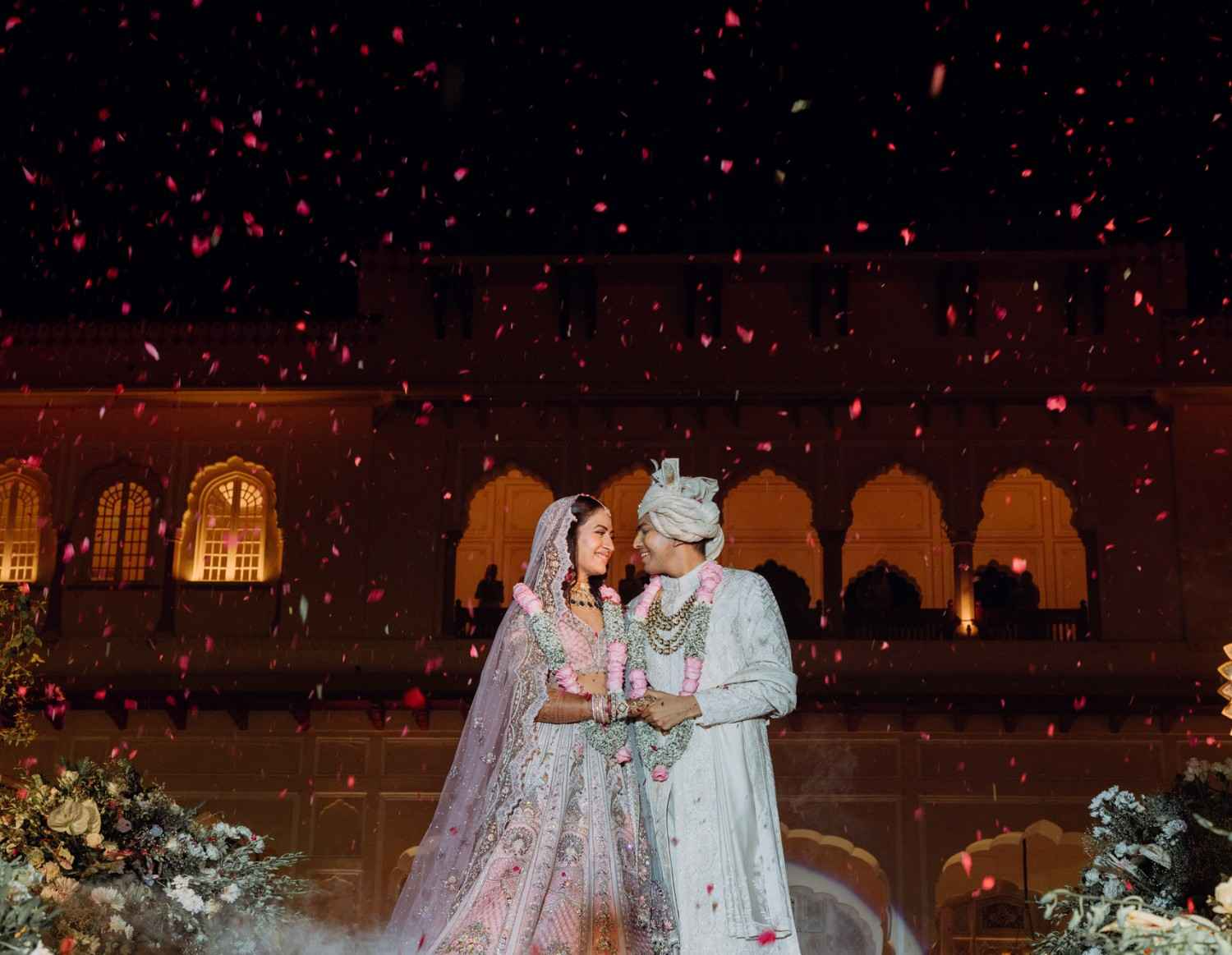
Rambagh Palace, Jaipur
Rambagh Palace was not built to host weddings. It was built in 1835 as a royal hunting lodge, expanded into a formal residence for Maharaja Sawai Ram Singh II, and later became home to Maharaja Sawai Man Singh II, before passing to Taj Hotels in 1957 as one of the most celebrated palace hotels in India. That history is what gives weddings at Rambagh Palace their particular weight. Few other addresses in Jaipur can offer a couple the experience of standing inside an actual royal residence on their wedding day, surrounded by 47 acres of Mughal gardens and three storeys of carved white Rajput facade.
For couples planning a wedding at Rambagh Palace, the appeal usually starts with that history and grows from there - the gardens, the original interiors, the sense that nothing about the place was assembled for the occasion. Konark Weddings has spent years designing weddings at Rambagh Palace across its lawns, gardens, and interior halls, and the lesson each time is the same: this is a venue that asks the decorator to listen before adding anything. Done well, a Rambagh Palace wedding feels inevitable - as though the celebration had simply been waiting for the right couple to arrive.
How Konark Weddings Designs Wedding Decor at Rambagh Palace
Rambagh Palace presents a different design problem than most luxury venues, because its own interiors are already so finished. The gold and cream Mughal arch panels of the Suvarna Mahal were not built as a blank canvas; they were built as a complete architectural statement. Our approach to wedding decor at Rambagh Palace begins by treating those existing surfaces as a conversation partner rather than a backdrop. A blush-pink stepped Art Deco stage set against that gold panelling - the clean contemporary geometry placed directly beside centuries-old relief work - creates a dialogue between two eras rather than a clash between them.
This is the principle behind every piece of Rambagh Palace wedding decor we design: read the room first, then add only what the room is asking for. The Mughal Gardens at blue hour, lit with hundreds of tea lights across the full lawn and brass torchères lining the aisle, are not decorated so much as revealed - the lighting design simply makes visible what the gardens were always built to be. A wedding designer working at Rambagh Palace has to resist the instinct to fill space, because the palace has already filled most of it with two centuries of architecture.
Rambagh Palace also has room for genuine contrast, which is part of why it remains one of the most rewarding venues for ambitious Rambagh Palace wedding design work. A cobalt-blue sangeet - electric wall washes, candlelit shelf installations, white neon strip lighting, a mirror-ball mannequin dressed in flowers - sits confidently inside the same palace as the gold Mughal halls, because Rambagh's authority is secure enough to hold both languages without either one diminishing the other.
The Spaces We Design For Weddings at Rambagh Palace
Mughal Gardens - Outdoor Lawn
The Mughal Gardens are where most ceremonies and receptions take place, and they are the reason so many couples begin planning a wedding at Rambagh Palace in the first place. Forty-seven acres of formal garden face the palace's carved white three-storey facade, and our work here is mostly about restraint: a long central aisle lined with brass torchères and white floral arrangements, tea lights scattered across the full lawn so the grass itself seems to glow, and a single decorated gate marking the entrance to the palace. The architecture does the heavy lifting. Our job is to frame it correctly.
Suvarna Mahal - Indoor Banquet Hall
The Suvarna Mahal was originally commissioned for formal royal banquets, and its gold-painted Mughal arch panels and ornate plasterwork remain the dominant visual element in the room. We design indoor mehndi and reception functions here with that in mind - a blush-pink Art Deco stage with cascading pink, white, and red florals and a cream fringe sofa is one example of decor that holds its own beside centuries-old detailing without competing for attention it was never going to win outright.
Rajput Room & Palace Ballroom
These interior spaces give us the controlled environment a full room transformation needs. The cobalt-blue sangeet concept - arched candle-wall installations holding dozens of pillar candles, white neon strips, navy velvet furniture, an entrance corridor turned into a blue-lit floral tunnel - depends on ceiling height and darkness that only the indoor halls can provide. Anyone searching for a wedding designer at Rambagh Palace who can deliver a complete, immersive sangeet environment rather than a decorated room will find that this is exactly the kind of space and the kind of brief we build for.
Rambagh Lawns & Terrace Gardens
The smaller garden spaces beyond the main lawn suit haldi mornings and other pre-wedding functions, where the scale is more intimate and the design world can be entirely self-contained. A sunflower-themed haldi - a flower-covered entrance arch, a striped yellow marquee tent with rattan furniture and wicker styling - is the kind of decor that depends on a garden setting like this one, where the outdoor surroundings become part of the composition rather than a backdrop to it.
Royal Wedding Decor We Have Built at Rambagh Palace
The peacock-dome mandap is the installation most couples ask about when they imagine royal wedding decor at Rambagh Palace. It is an octagonal white pavilion with a central dome, arched openings on every side, and black floral vine motifs hand-painted across each panel. A glittering white-and-black peacock sits at the dome's apex, tail sweeping down into trailing gypsophila. Inside the arches, curtains of jasmine and rose strings fall like rain from ceiling to floor, and one side rises into a tower of red, yellow, white, and pink roses reaching the full height of the structure. It is built, not arranged - closer to architecture than to florals.
The candle-field aisle is the second signature, and it is usually what people mean when they picture a wedding at Rambagh Palace at its most cinematic. Hundreds of tea lights are scattered across the entire lawn until the grass reads as a field of gold from a distance. Brass torchères line the aisle at even intervals, and the palace facade behind is lit in warm rose and amber so every carved arch and column becomes visible against the evening sky. The couple walks the length of that aisle toward a building that has stood for nearly two hundred years, lit exactly the way it was meant to be seen.
Indoors, the cobalt-blue sangeet candle wall does the same emotional work in a different key. Two arched alcoves, each with six or seven shelves of pillar candles at staggered heights, sit inside a room washed entirely in electric blue, framed by vertical white neon strips. Navy velvet sofas face the wall. It feels less like a decorated ballroom and more like a private members' room that happens to occupy a 19th-century palace - which is precisely the kind of unexpected register a Rambagh Palace wedding designer can reach for once the formal ceremony decor is settled.
Sunflower haldi decor at Rambagh Palace takes the opposite approach entirely - bright, daytime, garden-rustic. A sunflower-and-marigold arch frames the entrance; inside, a yellow-striped tent holds rattan furniture, sunflower cushions, and wicker styling, with lemons and pears used as natural table accents. Every material in the space belongs to the same idea, which is the standard we hold every installation to, however large or small the event.
And then there is the detail that tells a couple they have hired a design team rather than a decor vendor: a silver mannequin with a mirror-ball head, dressed in purple and pink blooms, standing in low fog against a navy sequin curtain at the edge of the sangeet. It is playful in a building that rarely allows itself to be. That contrast is deliberate, and it only works because everything surrounding it has already been designed with total seriousness.
Planning a Wedding at Rambagh Palace
Rambagh Palace is managed by Taj Hotels, which means planning a wedding here involves the palace's own events and hospitality team for venue booking, accommodation, and catering, alongside the specialist vendors a couple brings in for design, photography, and entertainment. Konark Weddings works as the wedding decorator within that structure - we coordinate directly with the palace's events team on installation logistics, structural approvals, and heritage property guidelines, so the design we have agreed with the couple can actually be built on the day.
Most weddings at Rambagh Palace run across three or four days: a haldi and mehndi early in the programme, a sangeet the following evening, and the wedding ceremony and reception as the final event. Each function needs its own design brief and its own space within the property, but all of them have to read as a single visual story by the time the wedding ends. That is the real work of design your wedding at Rambagh Palace requires - not just four beautiful events, but four events that clearly belong to the same couple and the same celebration.
If you are at the early stage of planning a wedding at Rambagh Palace, the most useful thing you can do is start the decor conversation six to eight months out. Installations at this scale - an octagonal mandap, a full tent interior, a complete ballroom transformation - need real lead time for sourcing, structural design, and on-site rehearsal before the wedding date arrives. The couples whose Rambagh Palace weddings are remembered years later are, almost without exception, the ones who gave their wedding event planner and decor team enough runway to do the work properly.
If Rambagh Palace is where you are getting married, this is a good time to start talking about decor. The palace has hosted royalty, heads of state, and some of the most photographed weddings in Jaipur's recent history, and it holds every celebration with the same quiet authority - provided the design is given the time and thought it deserves.
Konark Weddings has worked as wedding designer at Rambagh Palace across its gardens, halls, and lawns, through haldi mornings, candlelit sangeets, and ceremonies on the Mughal Gardens at blue hour. We know this palace the way a decorator only comes to know a place after returning to it again and again.
Get in touch to start designing your wedding at Rambagh Palace.
Frequently Asked
Questions
-
Yes - Rambagh Palace works with external wedding design studios, subject to Taj Hotels' standard vendor approval process and the property's heritage guidelines around structural installations and surface treatments. Konark Weddings has an established working relationship with the Rambagh Palace events team from years of designing weddings there, which makes the approval and coordination process considerably smoother. If you are sourcing your own decorator, we recommend confirming vendor approval with the palace early, so there is enough runway left for design development once that approval comes through.
-
Rambagh Palace, through Taj Hotels, has an in-house events team that manages the operational side of a wedding - venue access, accommodation, and in-house catering. Many couples also bring in an independent wedding planner for overall programme management across multiple vendors and days. Konark Weddings focuses specifically on wedding decor and design - the installations, florals, lighting, and overall visual direction - and we work alongside both the palace's events team and any planner the couple has engaged, so the decor fits seamlessly into the wider wedding programme.
-
Rambagh Palace can hold a wider range of styles than most heritage venues in Jaipur, because its own architecture is confident enough to support real contrast. Decor that extends the palace's existing Mughal-Rajput language - ivory and gold palettes, jasmine garland curtains, carved pavilion mandaps, brass torchère lighting - works beautifully here. So does decor that deliberately contrasts with it: a cobalt-blue sangeet room, a blush-pink Art Deco stage set against gold Mughal panelling, a mirror-ball sculpture in a navy velvet lounge. What ties both approaches together is that the decor has clearly been designed with the same level of intention as the building it sits inside.
-
Planning a wedding at Rambagh Palace starts with the palace's own events team at Taj Hotels for venue dates, room blocks, and catering, run in parallel with your decor, photography, and entertainment vendors. On the design side, we recommend bringing in your wedding decorator six to eight months ahead of the date - large installations like an architectural mandap or a full ballroom transformation need that much lead time to source, build, and rehearse properly. Konark Weddings coordinates directly with the palace's team throughout, so the decor plan and the venue's own operational requirements are aligned from the start.
-
Konark Weddings has spent over 18 years and 550+ weddings designing at Rajasthan's finest heritage properties, including extensive work as wedding designer at Rambagh Palace. Our installations here include the peacock-dome mandap on the Mughal Gardens, the candle-field aisle at blue hour, the cobalt-blue sangeet transformation, and intimate mehndi setups inside the Suvarna Mahal. We design specifically for each property's own architectural character, and Rambagh Palace - with its genuine royal history and its willingness to hold bold, contemporary decor alongside it - is a venue we return to often enough to know in real depth.
-
Rambagh Palace is widely considered the benchmark for a royal wedding in Jaipur. Built in 1835 and once the official residence of the Maharaja of Jaipur, it is now run by Taj Hotels as one of India's most celebrated palace hotels, with 47 acres of Mughal gardens and a three-storey carved Rajput facade that few other properties in Rajasthan can match. Couples weighing weddings at Rambagh Palace against other Jaipur venues are usually weighing image and atmosphere against everything else - and on that measure, Rambagh tends to win.
-
Six to eight months ahead of the wedding date is what we recommend for Rambagh Palace, and longer for multi-day celebrations or large bespoke installations. A peacock-dome mandap, a full tent interior, or a complete ballroom transformation all involve real fabrication - structural design, sourcing, and on-site rehearsal - and none of that can be rushed without it showing on the day. Konark Weddings takes on a limited number of weddings each season specifically so every Rambagh Palace celebration gets the time it needs.